
DBT In Schools Implementation of
DBT STEPS-A Curriculum
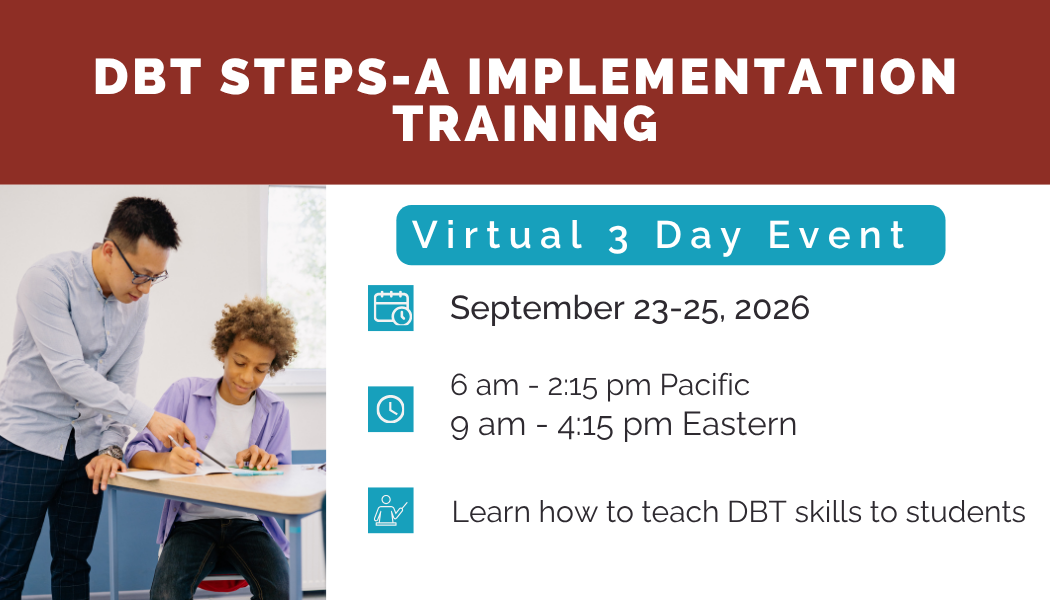
3 Day Live Virtual Training
16.75 CE Hours
Registration Information
Register With A PO
1. Click the appropriate link below
2. Submit your invoicing details in your client portal.
3. We will then send our W9 and an invoice.
DBT STEPS-A Implementation Training: $945 per person | Early Bird: $895 per person
4. Upload a PO to your client portal.
5. We will then send you a link to complete registration.
6. If paying with a credit card, please see the link to the right for direct registration >>>>>>>
If registering multiple people, please have contact information for all registrants ready before beginning registration. Each individual must be entered including name, email address, role, and grades served. Thank you.
$995 per person | Early Bird: $945 per person
• Group Rate (5 or more participants): $945 per person | Early Bird: $895 per person
Register with a Credit Card
Please ensure you have all necessary trainee information readily available.

Overview
The DBT STEPS-A Implementation Training provides instructors, teachers and school staff familiarity with the DBT STEPS-A curriculum. This training includes background information on how the DBT STEPS-A curriculum was developed, potential barriers and issues in implementation, solutions for student related challenges, and implementation strategies for teaching lessons. The training is designed to establish four basic elements necessary in implementing the DBT STEPS-A curriculum effectively:
A. Background and Development of the DBT STEPS-A curriculum
B. Structure and Implementation Considerations
C. Overview and demonstration of DBT STEPS-A lessons
D. Preparation and participant practice of teaching DBT STEPS-A lessons.Course OverviewTraining Information
-
High School & Middle School Teachers
School Administrators
School Counselors and Social Workers
School Mental Health Staff
Prevention Specialists
Behavioral Health Professionals
-
Participants attending the entire training may receive a certificate for 16.5 CE Hours.
DBT in Schools, LLC has been approved by NBCC as an Approved Continuing Education Provider, ACEP No. 7064. Programs that do not qualify for NBCC credit are clearly identified. DBT in Schools, LLC is solely responsible for all aspects of the the program.
DBT in Schools, LLC is recognized by the New York State Education Department's State Board for Social Work (NYSED SW)as an approved provider of continuing education for licensed social workers #SW-0838. Contact Hours: 16.5 Educational Methods: Lecture, Multimedia, Experiential Activities
DBT in Schools, LLC is recognized by the New York State Education Department's Office of Teaching Initiatives (OTI:NYSED)as an approved sponsor of CTLE for Professional Classroom Teachers, School Leaders and Level III Teaching Assistants. I certify that the individual listed above completed the CTLE cited above pursuant to Subpart 80-6 of the Regulations of the Commissioner of Education. NYSED Approved CTLE Sponsor ID #23849. Number of Hours Awarded: 16.5
-
Participants will be able to…
1. Explain the rationale for the DBT STEPS-A curriculum in middle and high schools.
2. Describe the continuum of the different applications of DBT which may be provided in the school context.
3. Explain how the DBT STEPS-A curriculum in a school differs from comprehensive DBT clinical treatment.
4. Utilize the DBT STEPS-A manual to prepare and deliver SEL lessons to classroom and/or small groups.
5. Describe the three states of mind.
6. Apply and teach the concept of dialectics and dialectical thinking.
7. Lead students through a mindfulness exercise and process the relevance of the exercise with students.
8. Explain mindfulness “what” and “how” skills.
9. Explain the Opposite Action skill to change emotions.
10. Explain the Check the Facts skill to regulate emotions.
11. Explain the WAVE skill for experiencing emotions.
12. Explain and teach the Distract with the ACCEPTS crisis survival skill.
13. Teach students how to understand the parts of an emotion using the Model of Emotions.
14. Utilize a DBT STEPS-A diary card as a progress monitoring tool with students.
15. Demonstrate teaching one skill from the interpersonal effectiveness module.